Food service facilities operating in urban dining corridors like Plaza Midwood along Central Avenue and Dilworth along East Boulevard contend with distinct microclimate pressures. The combination of intense Piedmont…
Food service facilities operating in urban dining corridors like Plaza Midwood along Central Avenue and Dilworth along East Boulevard contend with distinct microclimate pressures. The combination of intense Piedmont summer humidity, aging brick sewer connections, and continuous commercial grease accumulation creates high-risk harborage conditions for German cockroaches and structural vectors. Standard residential barrier sprays degrade rapidly under high-heat wash-down routines; effective commercial defense requires botanical-surfactant drain cleaning, non-repellent structural baits, and precise mechanical sealants along wet-wall plumbing penetrations. In historic retail strips such as Myers Park along Selwyn Avenue, multi-tenant utility chases allow vector migration between distinct business suites, requiring synchronized line isolation.
Selecting dedicated commercial restaurant sanitation over a generic recurring spray service protects food-contact surfaces from indiscriminate aerosol drift while satisfying Section 4-201 of the North Carolina Food Code. Standard bug treatments introduce pesticide volatility risks near prep tables and walk-in coolers without solving the biological biofilm attracting vectors. In contrast, bio-enzymatic foam treatments digest lipid deposits inside floor drains where phorid and drain flies breed. The physical trade-off centers on upfront prep: bioremediation and structural exclusion require deep physical access behind refrigeration lines and fry stations during non-operational hours, rather than a rapid ten-minute perimeter sweep during business shifts.
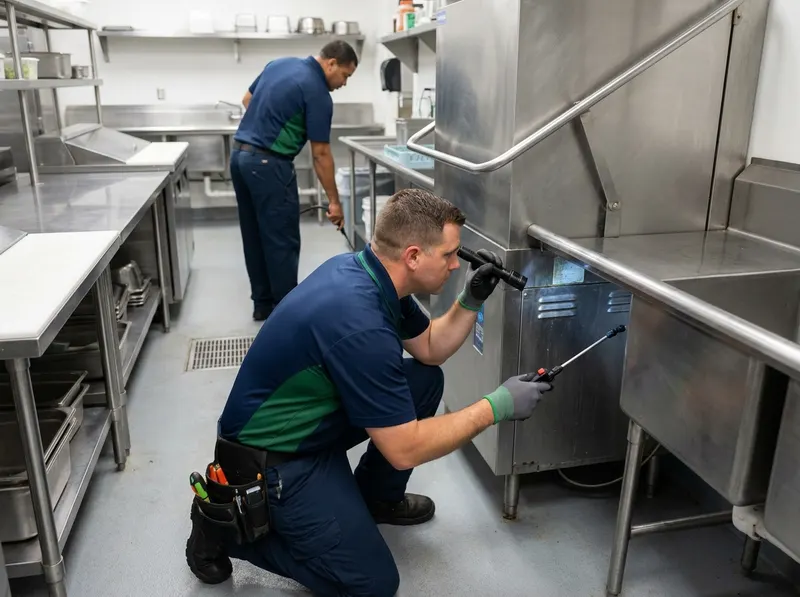
Operational execution follows a four-stage protocol: 1. A physical perimeter assessment maps all grease interceptors, mop basins, floor sinks, and plumbing penetrations under 100-foot-candle diagnostic lighting. 2. Non-volatile synthetic insect growth regulators and target-specific non-repellent microencapsulated baits are deployed directly into non-food void spaces and structural seams. 3. Active floor drains receive pressure-injected enzyme foam to eliminate the organic matrix where vector eggs incubate. 4. Detailed compliance documentation is logged directly into the facility safety binder to satisfy municipal health inspector reviews on demand. Direct dispatch for commercial assessments can be coordinated at (980) 470-3059.
Every job gets a firm, written price after a free on-site visit.
Tell us about your commercial restaurant sanitation and vector control job in Charlotte and we'll send a clear, written quote, usually the same day.
 ClearZone Pest Control